an editorial guide
luxury candles, near you.
there is no shortage of candles called luxury. there is, however, a meaningful shortage of candles that deserve the word. this guide is a quiet attempt to draw the line — what counts, what doesn't, and how to find the small number of makers within driving distance whose work earns the description. read it before you spend ninety dollars on something that will burn down in twenty hours.
what counts as a luxury candle
the word has been hollowed out. a glass jar, a beige label, an ambient name like silence or marrakech, and the candle is sold as luxury at fifty-eight dollars without anyone asking what is inside it. the actual definition is narrower and more material than the marketing.
a luxury candle is, at minimum, made from a clean wax — coconut, apricot, beeswax, or a blend of those three. paraffin is a petroleum byproduct and disqualifying regardless of price. soy is acceptable but structurally inferior to coconut for scent throw and burn quality, and most "soy" candles on the market are blends with paraffin to cut cost. the wick should be wood or unbleached cotton — never zinc-cored, never lead. the fragrance should be phthalate-free and disclosed; if a brand will not tell you what is in the scent, the scent is not the point.
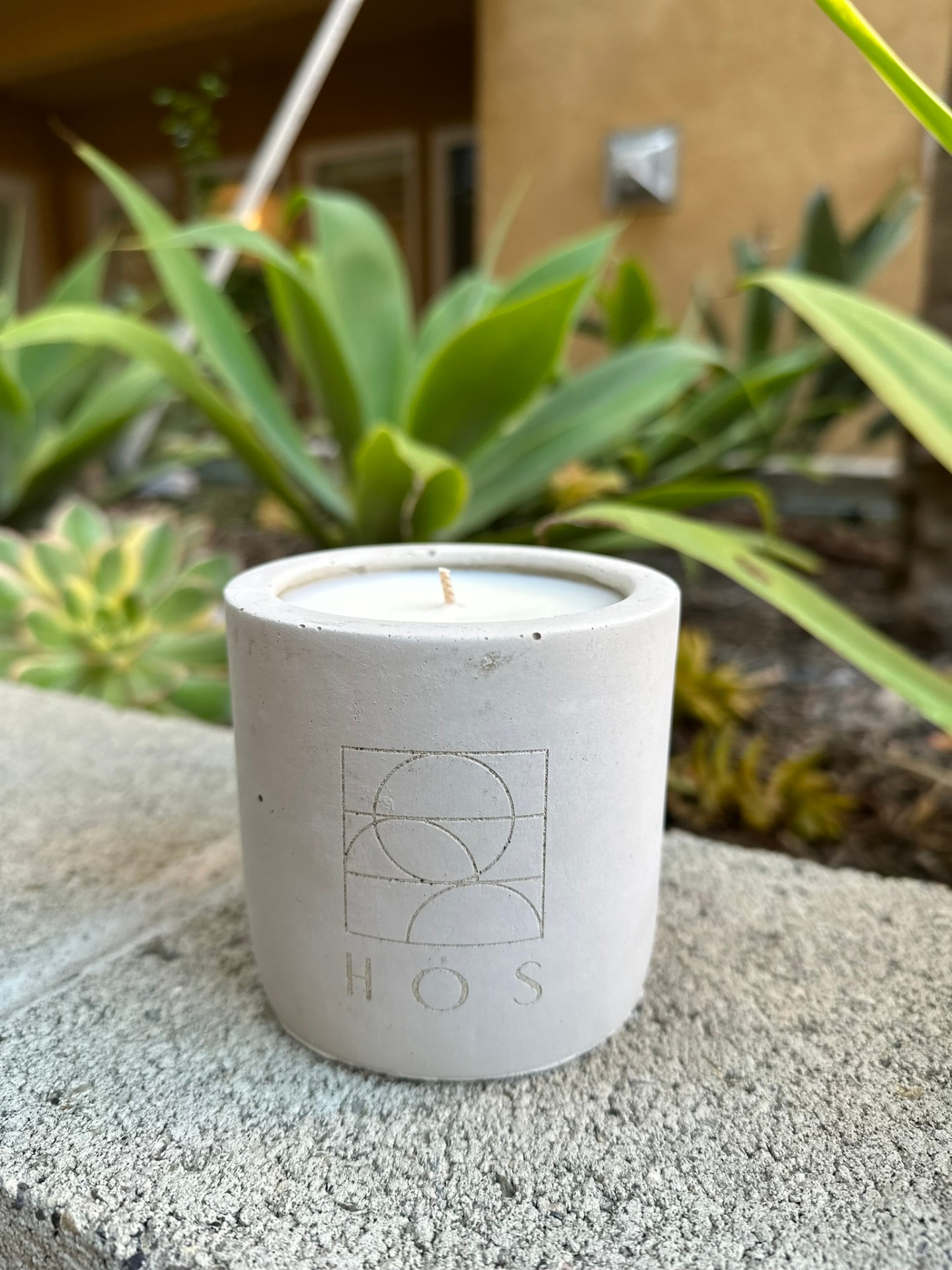
the vessel matters. it is the object you live with for fifty to one hundred and twenty hours and then keep, refill, or discard. a luxury vessel is hand-finished — concrete, ceramic, hand-blown glass, travertine, brass. it has weight. it has the small irregularities of having been touched. mass-produced machine-pressed glass is not a luxury vessel no matter how thick the label stock is. makers like nu los angeles hand-cast each concrete vessel individually, which is why no two are exactly alike — that is the tell.
burn time, traceability, and the hand of a real maker complete the definition. we cover all eleven criteria in detail in what makes a candle luxury.
why "near me" matters for luxury candles
shopping local is usually a values argument. with luxury candles it is also a quality argument. clean wax candles — coconut, apricot, beeswax — degrade faster than paraffin. fragrance throw peaks within the first six months of pour and softens noticeably after a year. when you buy from a small maker within your metro, you are usually burning a candle poured within the last four to ten weeks. when you buy from a national brand, you are often burning something poured nine months ago in a contract facility.
the second reason is the vessel itself. concrete, ceramic, and travertine vessels are heavy — the small ten-ounce concrete pour from nu los angeles ships at nearly four pounds. heavy objects in soft packaging arrive chipped at a depressing rate. local pickup, local delivery, or a maker with a studio in your city solves a problem you would otherwise discover by unboxing.
the third reason is the most underrated: a real maker can make you something. a custom scent, an engraved tag, a refill program, a private candle-making session for ten guests in your home. these things only happen with proximity. a candle bought from a website on the other side of the country is a product. a candle from a maker an hour away is a relationship.
the four signals of a real luxury candle
one — material honesty
the brand will tell you, on the product page and without prompting, what the wax is, what the wick is, what the fragrance contains, and where it is poured. if the answer to any of those is missing, vague, or behind a "request more information" form, the candle is not transparent enough to be luxury. transparency is not a marketing posture; it is a signal of supply-chain control.
two — the vessel as object
hold it. weigh it. look at the underside. a luxury vessel feels like something you would set on a shelf even if it were empty. it has a maker's mark or none at all — never a sticker. the rim is finished by hand, which means it is not perfectly round. that imperfection is the difference between a vessel and a container.
three — scent as composition
the scent should have a top, a heart, and a base. if you can describe what you smell after thirty minutes of burning in two words, the candle was built on a single accord — a flat oil dump, not a composition. luxury fragrance evolves over the burn the same way a perfume evolves on skin. a maker should be able to tell you the three to five notes and why they were chosen for that pairing.
four — the maker's hand
there is a person you can name. they answer email. they will pour a custom scent for an order of one hundred. they remember the name of the corporate client whose holiday gift went out two years ago. this is not romanticism — it is what separates a small, defensible luxury brand from a private-label white-label brand wearing luxury packaging. the question is simple: who made this. if there is no answer, walk away.
how to evaluate before you buy
five questions to ask, in person, by email, or via instagram dm. a real maker will answer all five within a day. anyone who hedges on more than one is selling you something that is not what they say it is.
- what is the wax composition, by percentage?
- what is the wick made of, and is it certified by the national candle association?
- are the fragrance oils phthalate-free and ifra-compliant?
- where and when was this batch poured?
- can i return or exchange it if the scent is not for me?
the fifth question is the quiet one. a brand confident in its product offers a return window. a brand that does not is selling something they are not sure you will love.
regional landscape
the luxury candle scene in the united states is concentrated in three metros, each with a distinct character. brief notes on what to expect in each — full city guides for los angeles, orlando, and miami.

los angeles
the densest luxury candle ecosystem in the country. the originals — boy smells, otherland — sit alongside a quietly growing roster of concrete-vessel and travertine-vessel makers working out of west adams, culver city, and marina del rey. the city's heavy candle culture is connected to its wellness and architecture cultures, which is why the vessels here lean architectural rather than decorative. see one of the local makers.

orlando
underrated. the central florida luxury market is younger, growing fast, and underserved by the boutique scale that defines luxury candles elsewhere. a small number of studios — including the orlando-based nu los angeles studio — pour for the orlando, winter park, and lake nona luxury and corporate-gifting markets.

miami
high intent, low local supply. miami's design district and brickell drive the demand for hand-cast vessels and custom scents — particularly for hospitality and corporate gifting — but most of the candles sold as luxury in miami are imported from los angeles, paris, or new york. local pour is the exception, not the rule. one of the few makers serving the metro.
a candle is the last analog object in a digital house. when it is real, it slows the room down. when it is not, it just smells like something. the difference is worth the work of finding.
continue reading: what makes a candle luxury — the eleven standards